An Invention Born at His Wife's Fingertips: The Band-Aid
She kept cutting her fingers in the kitchen. He wanted to make something she could put on by herself. That little strip of tape with gauze on it found its way into nearly every American home.
In 1920, Earle Dickson of New Jersey worked as a cotton buyer for Johnson & Johnson. His wife, Josephine, often cut or burned herself while cooking and doing housework.
To cover a cut, you had to cut a piece of gauze and tape it on separately. That was hard to do alone, and on busy fingers it fell right off. Dickson wanted something she could put on herself.
Little squares of gauze on tape
He laid out a long strip of surgical tape and placed small squares of gauze along it, then covered the sticky side with crinoline so it would stay fresh. Whenever she needed one, she could cut off a piece and press it on. James Wood Johnson of the company liked the idea and put it into production.
The Band-Aid's road
- Invented: 1920, by Earle Dickson
- First product: strips about 2½ inches wide and 18 inches long
- First-year sales: $3,000
- 1920s: included in Boy Scout first-aid kits
- 1924: machine mass production begins
A slow start
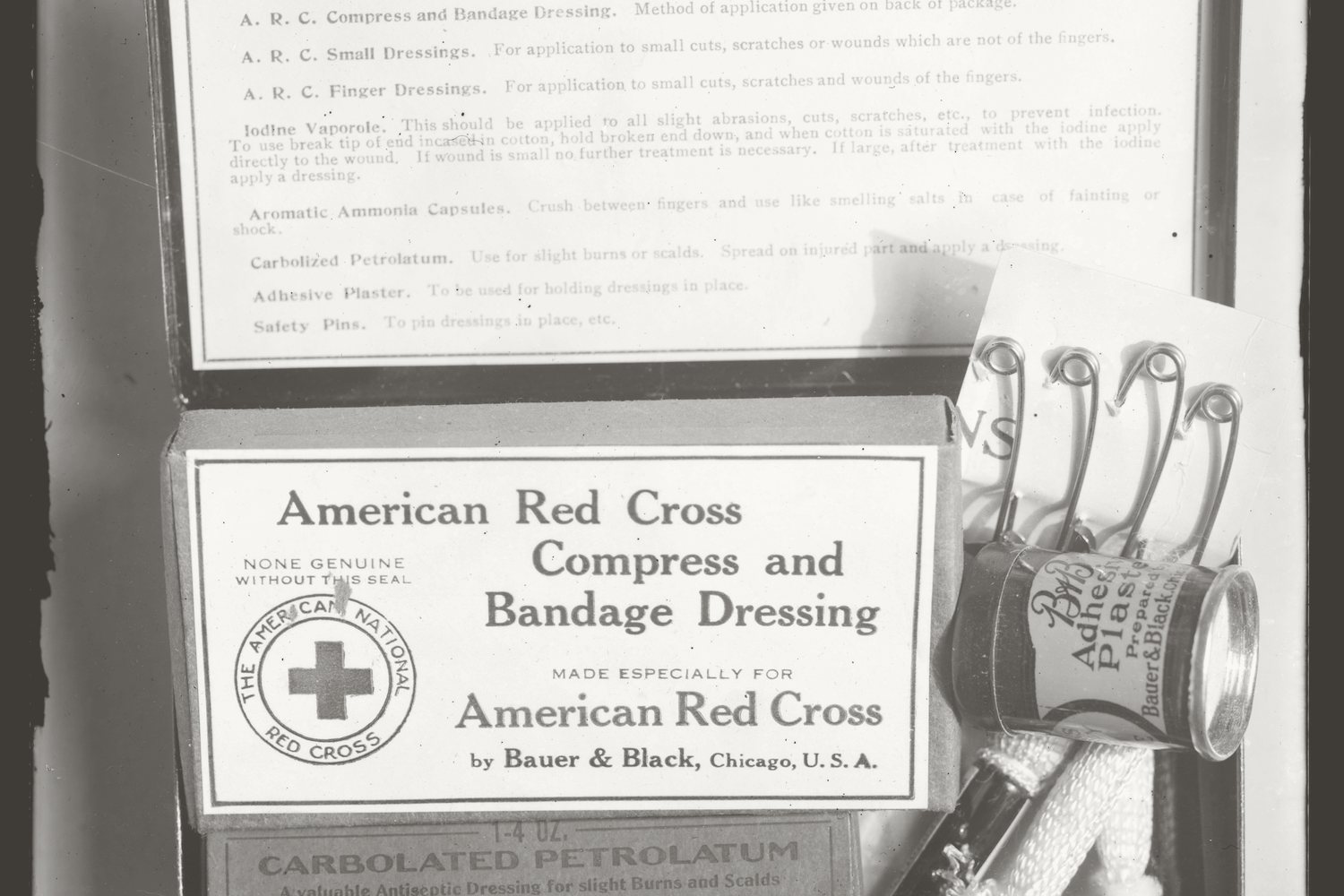
In the first year only $3,000 worth sold, because people didn't know how to use them. The company sent salesmen to demonstrate, and in the 1920s put bandages in Boy Scout first-aid kits. From 1924, machines made them by the millions. Dickson rose to become a vice president of the company.
Sources
- Earle Dickson (Wikipedia: wife Josephine, 1920, James Wood Johnson, 1924 mass production, $3,000 first-year sales)
- Smithsonian Magazine: Get Stuck on Band-Aid History (2½ × 18-inch strips, Boy Scouts)
- Library of Congress: Red Cross pocket first-aid kit (1919–1929)
Dollar conversions use the U.S. Bureau of Labor Statistics CPI-U (1926 annual average 17.7; September 2026: 336.94), a factor of about 19.