A Norwegian Engineer Files the Patent Behind the Spray Can
In the autumn of 1926, Erik Rotheim of Oslo asked for a patent on a bottle that could spray its contents under its own pressure. The idea now sits in almost every bathroom and kitchen.
Some of the biggest businesses of the 20th century started with a simple question. For Erik Rotheim, a chemical engineer in Oslo, the question was: how do you spread a thin, even coat of something sticky without a brush?
His answer was a pressurized can. On October 8, 1926, Rotheim filed a patent application in Norway for a method of "atomizing or distribution of liquid or semiliquid materials." The idea: seal the product inside a strong metal bottle together with a gas that turns to liquid under pressure. Open a valve, and the gas pushes the product out as a fine spray.
What the patent says
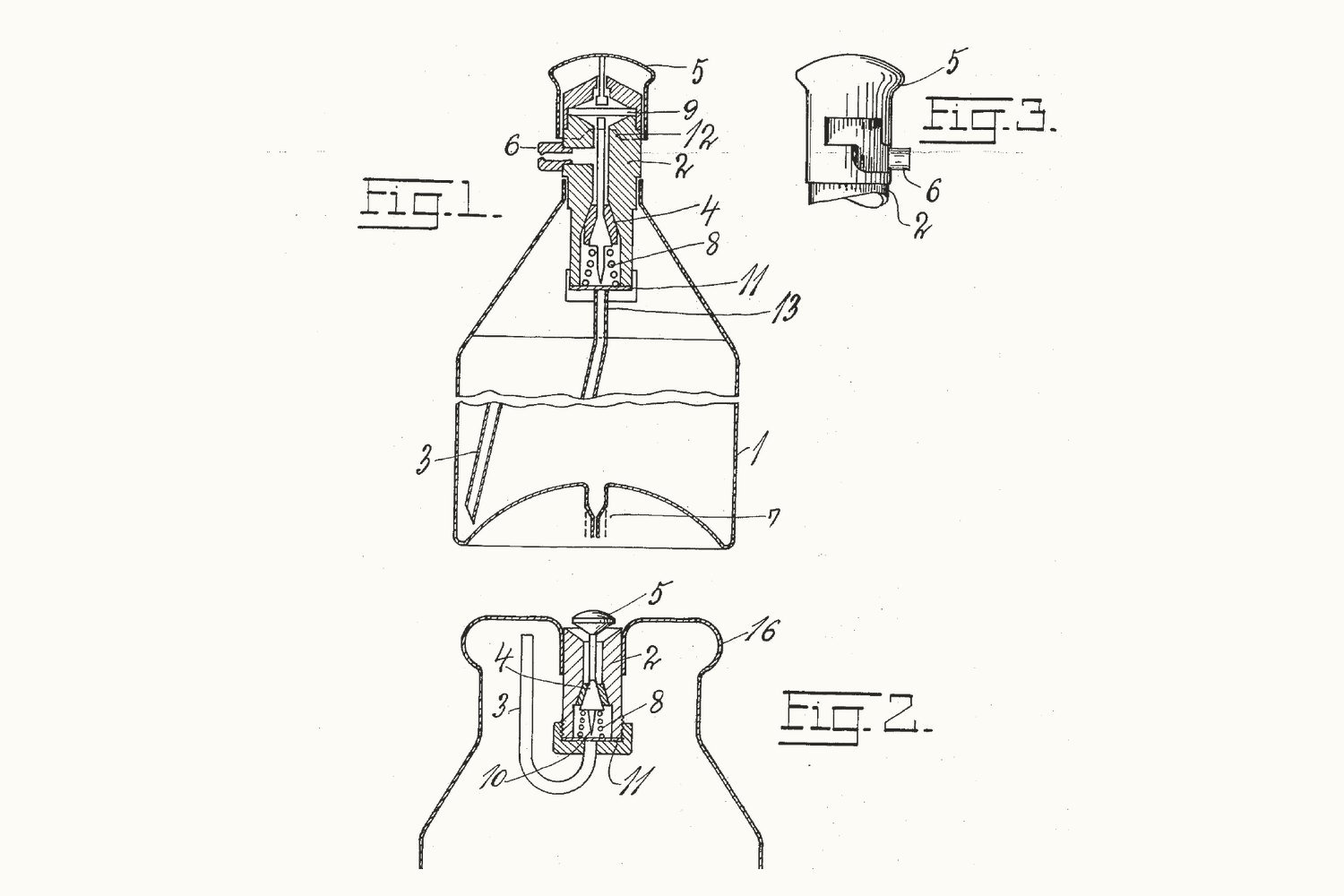
When Rotheim filed in the United States the next year, his application spelled out the details. The propellant he described was dimethyl ether, a gas at room temperature that becomes a liquid under pressure. "The volume of methyl ether as a gas is about 350 times as large as that of the same quantity in a liquid state," the patent explains — so a small amount of liquid propellant can drive out a whole bottle of product. The drawings show a bottle with a pipe reaching into the liquid, a valve, a push knob and a small spray outlet: the basic layout of a spray can today.
The paper trail
- Norwegian application: October 8, 1926
- U.S. application: September 30, 1927
- Norwegian patent granted: 1929
- U.S. Patent 1,800,156 granted: April 7, 1931
- The patent was later sold to an American company for 100,000 Norwegian kroner
From one patent to a world market
Rotheim's own business never took off — his cans were heavy and expensive to make, and the company that produced them went bankrupt in 1939. But the idea kept improving. During World War II, U.S. government scientists used a refillable aerosol "bug bomb" to protect soldiers from malaria-carrying mosquitoes, and in 1949 a cheap, crimp-on plastic valve made spray cans affordable for everyday products. Paint, hairspray, whipped cream, cooking oil and sunscreen followed.
Today aerosol cans are made by the billions every year. It all traces back to a patent filed by one engineer in Oslo, one hundred years ago this autumn.
Sources
- Erik Rotheim, U.S. Patent 1,800,156 (filed Sept. 30, 1927; in Norway Oct. 8, 1926; granted April 7, 1931)
- Erik Rotheim (Wikipedia)
- Store norske leksikon: Erik Rotheim
Dollar conversions use the U.S. Bureau of Labor Statistics CPI-U (1926 annual average 17.7; September 2026: 336.94), a factor of about 19.